Publications
Our groundbreaking research published in the world's leading scientific journals.
Sense Codon Reassignment Enables Virus-Resistant Production Strains and Encoded Non-Natural Polymer Synthesis
Robertson, W.E., Funke, L.F.H., de la Torre, D., Fredens, J., Elliott, T.S., Spinck, M., Christova, Y., Cervettini, D., Böge, F.L., Liu, K.C., Buse, S., Maslen, S., Salmond, G.P.C., Chin, J.W. Science 372(6546), 1057–1062 (2021)
Sense codon reassignment in recoded E. coli simultaneously enables two commercially valuable capabilities: inherent resistance to viral infection and the encoded synthesis of non-natural polymers with properties not found in biological systems. The virus resistance eliminates a major contamination risk in industrial fermentation, while polymer synthesis demonstrates the platform's potential beyond therapeutics into advanced biomaterials.
Key publications
Syn61: Total Synthesis of E. coli with a Fully Recoded Genome - The Foundation of Constructive Bio's Platform
Fredens, J., Wang, K., de la Torre, D., Funke, L.F.H., Robertson, W.E., Christova, Y., Chia, T., Schmied, W.H., Dunkelmann, D.L., Beránek, V., Uttamapinant, C., Gonzalez Llamazares, A., Elliott, T.S., Chin, J.W.
Nature 569(7757), 514–518 (2019)
Why it matters: Syn61 is the origin of Constructive Bio's programmable biology platform. By proving that an organism can survive with a compressed genetic code, this work created the 'blank codons' that Constructive Bio's BioForge platform now uses to encode non-canonical amino acids into peptide therapeutics at industrial scale. Every subsequent advance, from multi-ncAA incorporation to virus-resistant production strains, builds directly on Syn61.
Engineered triply orthogonal pyrrolysyl–tRNA synthetase/tRNA pairs enable the genetic encoding of three distinct non-canonical amino acids
Dunkelmann, D.L., Willis, J.C.W., Beattie, A.T., Chin, J.W.
Nature Chemistry 12(6), 535–544 (2020)
Why it matters: One of the key enabling steps toward multiplexed ncAA incorporation and the programmable synthesis of chemically richer biomolecules.
REXER and GENESIS: The Genome Writing Toolkit for Creating Custom Synthetic Genomes in E. coli
Robertson, W.E., Funke, L.F.H., de la Torre, D., Fredens, J., Wang, K., Chin, J.W.
Nature Protocols 16, 2345 (2021)
Why it matters: REXER and GENESIS are the 'how' behind Constructive Bio's genome synthesis capability. They enable the precise, large-scale rewriting of bacterial genomes that produces the company's recoded production organisms. Having a published, validated protocol in Nature Protocols demonstrates the robustness and reproducibility of the approach that underpins the BioForge platform.
White papers
The Genome Synthesis Revolution
The Genome Synthesis Revolution
Reprogramming Life
Reprogramming Life
Programmable biomolecules of the future
Programmable biomolecules of the future
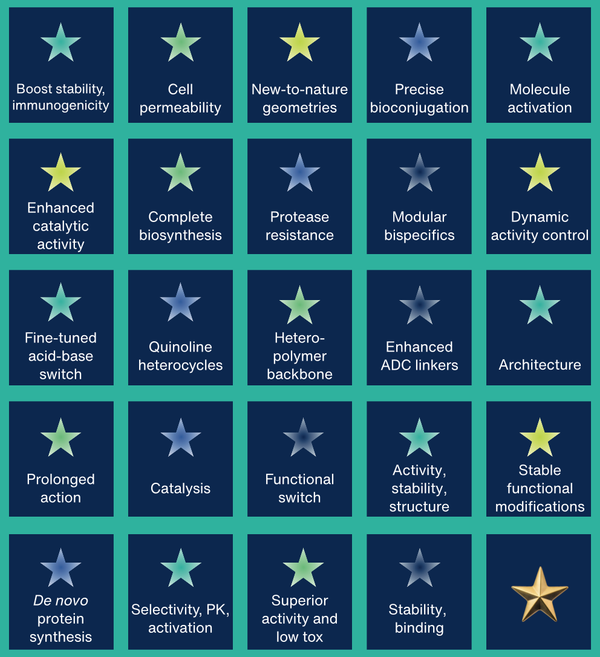
2025 Non-Canonical Amino Acid Advent Calendar
Bringing together all of December 2025's non-canonical Advent calendars.
Selected publications
Syn57: E. coli Engineered with the Most Compressed Genetic Code Ever Created, Freeing Seven Codons for ncAA Incorporation
Robertson, W.E., Rehm, F.B.H., Spinck, M., Schumann, R.L., Tian, R., Liu, W., Gu, Y., Kleefeldt, A.A., Day, C.F., Liu, K.C., Christova, Y., Zürcher, J.F., Böge, F.L., Birnbaum, J., van Bijsterveldt, L., Chin, J.W.
Science 390, eady4368 (2025)
The creation of Syn57, an Escherichia coli strain engineered to function with just 57 codons, the most radically recoded organism ever made. Over 100,000 changes to the genome removed seven codons from the entire genetic code, freeing them for reassignment to non-canonical amino acids. Syn57 extends Constructive Bio's foundational Syn61 work by demonstrating that even deeper genome recoding is viable, substantially expanding the capacity for incorporating multiple distinct ncAAs into peptides and proteins produced via fermentation.
Read paper ↗Genetic Code-Locking Gives Recoded Organisms Stable Virus Resistance, Eliminating a Key Biomanufacturing Risk
Zürcher, J.F., Dickson, A., Kappes, T., Kleefeldt, A.A., Liu, K.C., Salmond, G.P.C., Chin, J.W.
Biochemistry 64, 3093 (2025)
Genetic code-locking confers stable virus resistance to recoded organisms. Because viruses depend on the host cell's standard genetic code to replicate, organisms with refactored codes become inherently resistant to viral infection. This research demonstrates that the resistance is stable over many generations, addressing one of the most significant contamination risks in industrial biomanufacturing where viral outbreak can destroy entire fermentation batches of peptide therapeutics.
Read paper ↗Automated Orthogonal tRNA Generation Removes a Key Bottleneck in Scaling Non-Canonical Amino Acid Incorporation
Spinck, M., Guppy, A., Chin, J.W.
Nature Chemical Biology 21, 657 (2024)
Automated generation of orthogonal tRNAs for genetic code expansion. Orthogonal tRNAs are essential components for incorporating non-canonical amino acids into proteins, but creating them has been a manual, time-consuming bottleneck. This automated approach accelerates the development of new tRNA/synthetase pairs, enabling faster expansion of the ncAA toolbox available for engineering peptide therapeutics with enhanced properties through Constructive Bio's fermentation-based manufacturing platform.
Read paper ↗Orthogonal Replication System Enables Accelerated Directed Evolution of Proteins in Synthetic E. coli
Tian, R., Rehm, F.B.H., Czernecki, D., Gu, Y., Zürcher, J.F., Liu, K.C., Chin, J.W.
Science 383, 421 (2024)
A synthetic orthogonal replication system enables accelerated directed evolution of genes in E. coli without affecting the host genome. By replicating target genes on a separate, error-prone system, proteins can be rapidly evolved and optimised while the production organism remains genetically stable. This capability enables rapid optimisation of ncAA-containing proteins for therapeutic applications through Constructive Bio's platform.
Read paper ↗Non-Standard Backbone Chemistries Added to the Genetic Code of a Living Organism for Enhanced Peptide Therapeutics
Dunkelmann, D.L., Piedrafita, C., Dickson, A., Liu, K.C., Elliott, T.S., Fiedler, M., Bellini, D., Zhou, A., Cervettini, D., Chin, J.W.
Nature 625, 603 (2024)
The incorporation of α,α-disubstituted and β-linked monomers into the genetic code of a living organism. These non-standard backbone chemistries produce peptides with fundamentally altered structural properties including enhanced resistance to proteolytic degradation — a critical limitation of conventional peptide therapeutics. This work directly enables Constructive Bio's platform to produce next-generation peptide drugs with longer half-lives and improved oral bioavailability through fermentation-based manufacturing.
Read paper ↗